Posts mit dem Label kusudama werden angezeigt. Alle Posts anzeigen

Dienstag, 30. Juni 2020

Onaris Stern

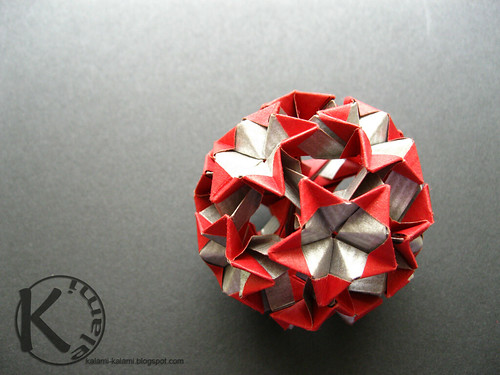
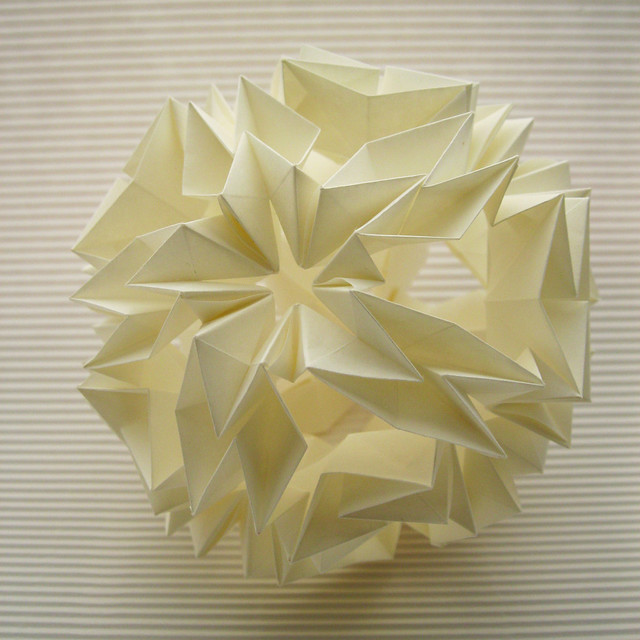
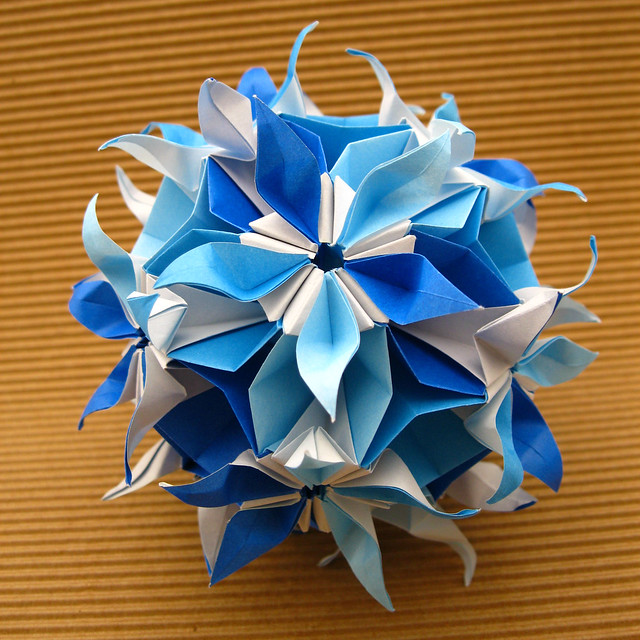
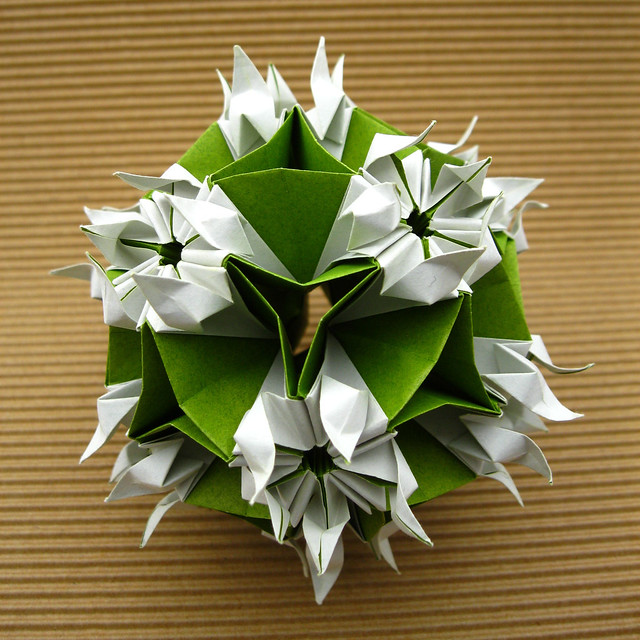
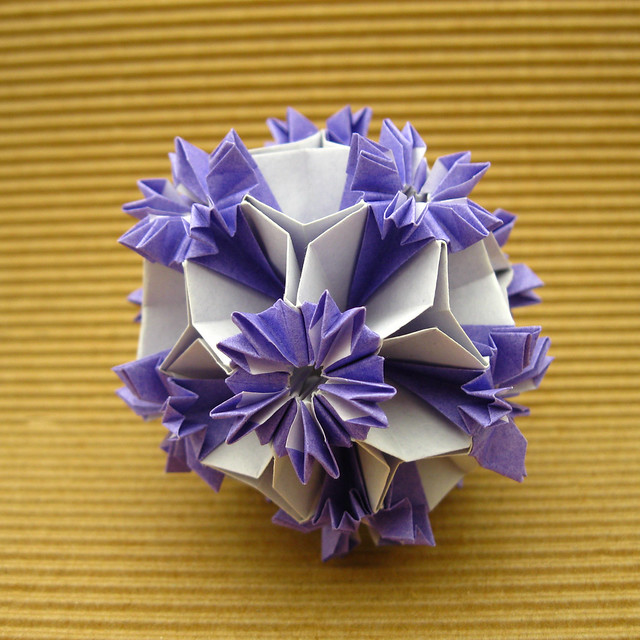
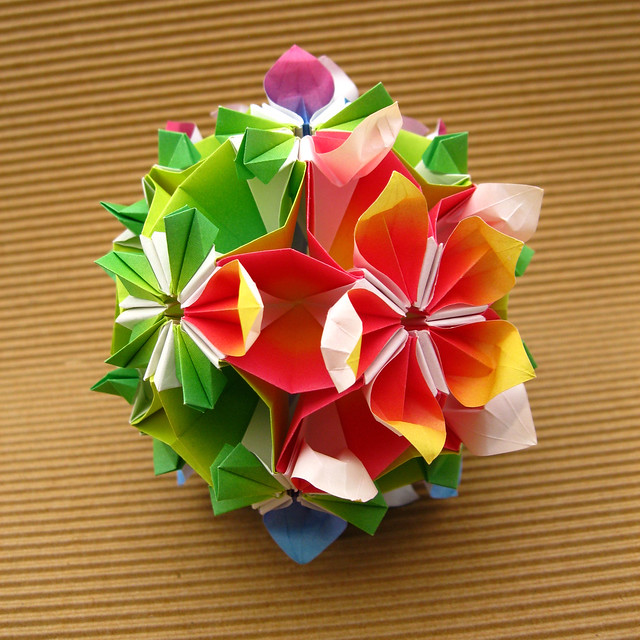
Diese Kugel trägt den Namen Onaris Stern, benannt nach einer lieben Freundin. Onaris ist eine von vielen, die in diesem Jahr ihre Hochzeit nicht ganz so feiern können, wie sie es geplant hatten. Doch Onaris und natürlich auch ihr in wenigen Stunden angetrauter Ehemann haben den Kopf nicht hängen lassen. Statt dessen haben sie in kürzester Zeit eine alternative Feier auf die Beine gestellt, die etwas ganz Besonderes werden wird.
Alles Gute Euch beiden!
This globe is called Onaris Star, dedicated to Onaris, a dear friend of mine. Onaris is one of so many, who can't celebrate their wedding as planned this year. But Onaris and of course her very soon to be husband didn't give up. Instead they organized in only a few week a party, that is going to something outstanding and special.
All the best to you!

Montag, 17. April 2017

Vorbereitung für das deutsche Treffen

eine kleine Vorschau auf das Diagramm - a sneekpeek at the diagram
In gut einem Monat ist es wieder soweit und hunderte Origamifreunde treffen sich bei der 29. Origami Convention des deutschen Vereins in Bonn. Alljährlich möchte ich natürlich auch ein oder zwei Diagramme für den Tagungsband zur Verfügung stellen. Dieses Mal hat mich Robin (Praise Pratajev) dazu überredet, das Modell 'Stars Stars Stars' zu zeichnen. Etwas, dass ich aus dem Grund nicht gern tue, weil ich es wahnsinnig schwer finde, modulare Kugeln als Vektorgrafik zu zeichnen. Aber heute habe ich mich neben der notwendigen Arbeitsvorbereitung und dem lauschen meines Lieblingsradiosenders daran gesetzt und etwas zusammengeschustert.

'Stars Stars Stars' - Gerade erst bemerkt, das Bild wurde hier auf dem Blog noch gar nicht gezeigt - I just noticed, I've never put a picture of this model on the blog
Gleichzeitig kann ich diese Gelegenheit gleich nutzen, um hier auf dem Blog auch noch den jüngsten Vertreter der 'Stars' Serie vorzustellen: 'Stars again'

und noch ein Modell der Serie: 'Stars Stars Stars Stars' - and another model of the series: 'stars stars stars
In a bit more than a month hundreds of Origami enthusiasts are meeting at the 29th Origami Convention of the German Origami Society in Bonn. Every year I'd like to enter one or two diagrams for the convention book. This year Robin (Praise Pratajev) suggestet to draw the model 'stars stars stars'. Something I don't love to do because it is very difficult to me to make a vector graphic of a modular globe. But today, next to preparing work and while listening to my favourite radio channel, I sat down and put something together.

This is also a good opportunity to present the youngest member of the 'stars' series on the blog: 'Stars again'

'stars again'

Sonntag, 19. Februar 2017

Was von 2016 übrig bleibt - What's left of 2016

Schaut man sich hier auf dem Blog um, könnte man meinen, dass ich gar nicht so viel Origami falte. Aber das stimmt nicht, denn gefaltet wird täglich. Leider schaffe ich aus den verschiedensten Gründen aber nicht immer meine Resultate zu fotografieren, im Netz hochzuladen und dann auch noch vernünftig vorzustellen.
Deshalb will ich in den kommenden Posts noch nachträglich zeigen, was im vergangenen Jahr auch entstanden ist, aber bisher undokumentiert blieb.
Den Anfang machen zwei Kusudama, die schon irgendwie ganz schön sind, aber mir jetzt nicht als so super herausragend vorkommen.

Having a closer look at this blog one might think, I don't do that much Origami. But that's not true, I fold something everyday. Unfortunately due to different reasons I don't always find the time to take pictures, upload it to the internet and presnt it in a proper way.
That's why the upcoming posts are a retrospective of things made last year but have been undocumented so far.
In the beginning there are two kusudama that are somehow nice but not perfect.


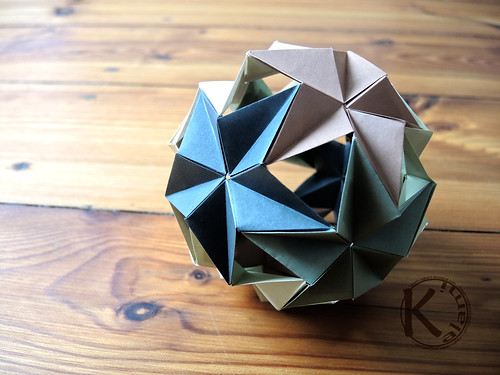
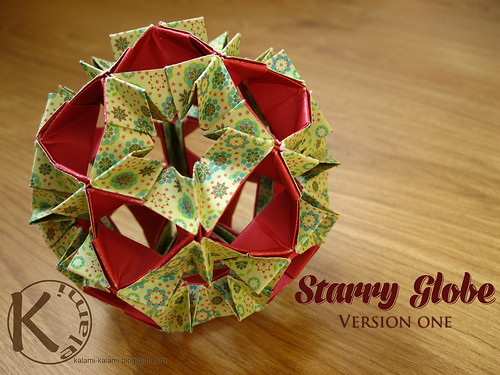
Nummer 1 entstand kurz nach der letzten deutschen Convention in Erkner. Ich habe mit Würfelformen experimentiert und versucht diese miteinander zu verbinden. Da diese Module schnell viel zu dick wurden, habe ich einmal mehr zusätzliche Module entwickelt, die die eigentlichen Einzelteile zusammenhalten - Adapter sozusagen. Dadurch steigt allerdings die Anzahl der Module pro Kugel deutlich an, in diesem Fall auf 60 (30+30 Module).

The first one was made shortly after the last German Origami Convention in Erkner. I was experimenting with cube shapes and tried to find ways to connect them. As these model easily became very thick and bulky, I developed extra units to combine them to a globe. But this means you have to fold 60 instead of 30 units per model (30+30 units).


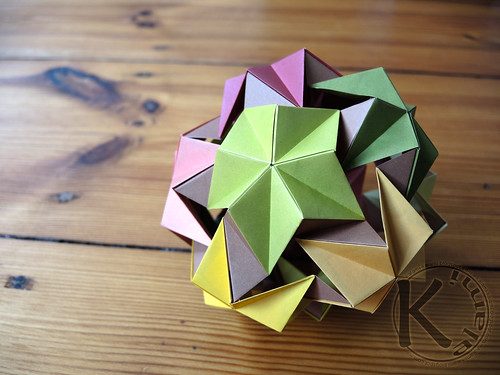
Das andere Modell gefällt mir sehr von der Form her und es wird auch nur aus 30 Quadraten erstellt, doch leider ist das Zusammenfügen der Einzelteile bei den letzten 3 Modulen nicht mehr möglich. Ich musste daher das Foto aus einem günstigen Winkel machen... Ich bin an einer überarbeiteten Version dran, nur kamen mir dann andere Ideen in die Quere, denen ich ersteinmal nachgegangen bin, so blieb die zweite Variante bisher unvollendet.

For the other model I like the shape and it only needs 30 units, but it is impossible to insert the last three modules properly. I had to take the picture from a good ankle, so you can't see this... 
I already started a better version, but then other ideas popped into my mind, which I followed first, so variation number two remains unfinnished so far.

Samstag, 30. Juli 2016

Inspiration

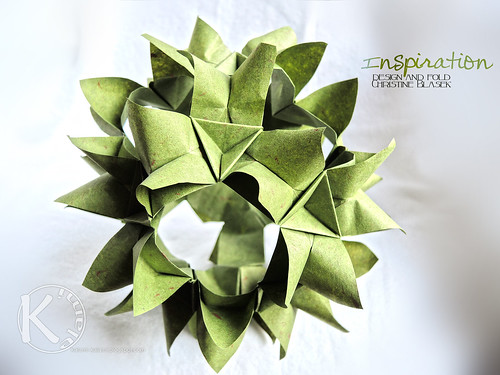
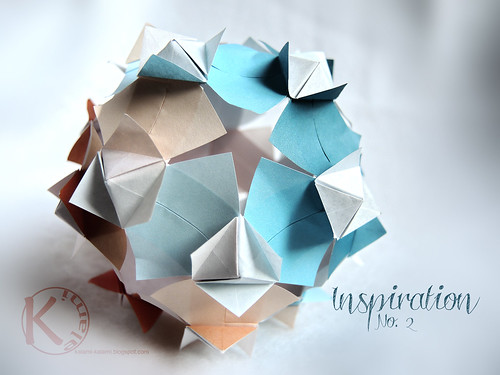
Wenn ich modulares Origami entwerfe, dann reicht mir oft eine kleine Faltsequenz aus, die mir so sehr gefällt, dass ich sie in einer Kugel integrieren möchte. Besonders haben es mir dabei Formen angetan, die rund und geschwungen sind. Auf diese Weise kann man viel besser florale und natürliche Strukturen nachempfinden.
Während der Origami Convention, dieses Jahr in Erkner, begegnete mir solch eine Faltung. Versteckt ist sie in einer niedlichen kleinen Meise, die ich im Workshop von Sébastien Limet lernte. Bereits als Sébastien sagte, wir dürfen bei dem Modell nicht alle Falten durchziehen, wurde ich hellhörig. Das bedeutet, man faltet bis zu einem bestimmten Punkt und der übrige Teil des Papiers wird nur gebogen. Bei der Meise entsteht auf diese Art der obere Teil des Kopfes.
Das Original ist hier
Hat man eine solche Faltsequenz, beginnt der schwierige Teil. Man muss das übrige Papier dazu verwenden, eine Tasche und Lasche zu falten, um die einzelnen Module miteinander zu verbinden. Weil ich die Faltung nicht vergessen wollte, habe ich schon während des Workshops angefangen, daran herumzutüfteln. Manchmal, ganz selten, greift aber einfach eins ins andere und am Ende unseres Lehrgangs hatte ich nicht nur das fertige Vögelchen in der Hand, sondern auch drei miteinander verbundene Module. Den Rest des Tages faltete ich dann fleißig Module und kurz vor Mitternacht war der Prototyp dann tatsächlich schon fertig. 

Ich der darauffolgenden Woche habe ich noch eine weitere Variante des Modells gefaltet. Danach war erstmal Ruhe, aber ich kann schon so viel verraten, ich bin wieder dran und habe eine weitere Idee, an der ich gerade falte.
das Papier ist von der "Eifeltor Mühle"
When I'm designing modular Origami, sometimes it is enough to have a short folding sequence, that I'd like to include in a globe. Especially round shapes gain my interest. With these shapes you can imitate natural and floral structures much better.
During this years Origami Convention in Erkner, I found such a perfect fold. Hidden in a cute little tit, that I learned in a workshop by Sébastien Limet. Already at the beginning, when Sébastien said, some of the folds needn't to be folded through, he got my attention. This means, you fold the paper just to a special point and the rest of it is just bent. For the tit it is the upper part of the head.
das Papier ist von "Valley Folder"
Have you found such a folding sequence, the hard part is about to begin. You have to use the rest of the paper to form a pocket and a flap, to join the units with each other. Because I didn't want to forget the folds, I already started to experiment on it during the workshop. Sometimes, really seldom, one leads to the other and at the End of the lesson I was not only holding a little bird in my hand, but also three connected units.The rest of the day I folded modules and just before midnight the prototype was finished.

In the upcoming week I also folded a variation of the model. After this, it went quiet about it, but I can tell you, I had a new idea and these days, I'm working on it.

Samstag, 6. Februar 2016

Ringos Sterne Teil 2

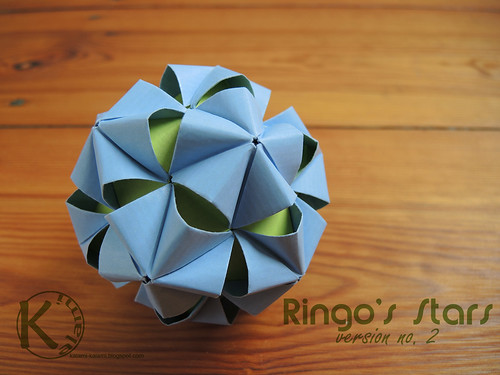
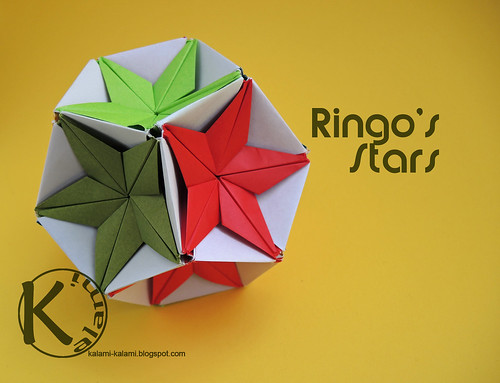
Im letzten Beitrag berichtete ich von einer Kugel, die ich aus dem Modell 'Ringos Stern' entwickelt habe. Da ich noch nicht so sehr zufrieden mit dem Ergebnis war, habe ich mit dem Modul weiter herumexperimentiert.
Version zwei hat nun keine ausgeformten Sterne, sondern rund belassene Elemente. Außerdem sind die Spitzen nun nicht nach innen, sondern nach außen gerichtet. Was sich nach wie vor sehr schwierig gestaltet ist das Zusammenbauen. Ohne Klammern geht hier gar nichts.


In the last post I wrote aboute a globe I made out of the model 'Ringo's Star'. As I wasn't that satisfied with the result, I kept on experimenting with the unit.
Version two cames without the stars, but with round elements. In addition to this the tips are now pointing outwards instead of inwards. Still the trickiest part about it is putting the units together. Without clips it is unmanageable.

Der erste Versuch - The first version

Mittwoch, 21. Oktober 2015

Flower of Scotland

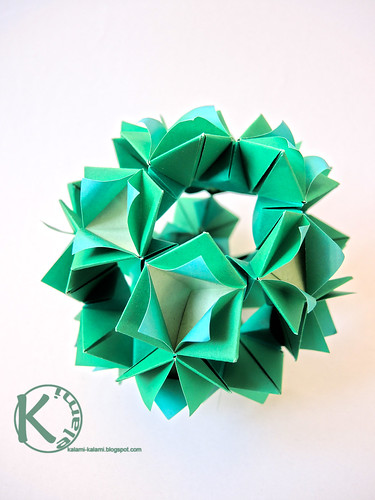
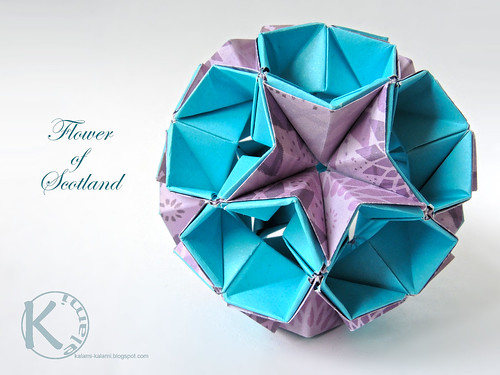
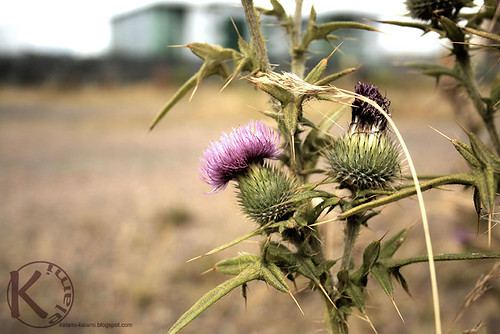
Heute zeige ich ein Modell, dass es eigentlich bereits seit über einem Jahr gibt, doch aus irgendeinem mir unerfindlichen Grund noch immer nicht fotografiert wurde. Es ist ein einfaches Kusudama, gefaltet aus 30 Quadraten und über einen schönen Verschlussmechanismus verbunden, dass die einzelnen Module auch beim Zusammensetzen nicht auseinander fallen. Klebstoff wird demzufolge nicht benötigt. Bereits im Mai hatte ich das Modell auf dem Origami Deutschland Treffen ausgestellt und dort festgestellt, dass es noch keinen Namen hatte. Spontan entschied ich mich für "Flower of Scotland", da es während meines Urlaubs in Schottland 2014 entstanden ist und auch noch das Lila der schottischen Nationalblume, der Distel, enthält. Gleichzeitig ist dies auch der Titel der inoffiziellen Nationalhymne des Landes.

Am vergangenen Sonntag ergab sich dann ein Grund nun endlich dieses Modell zu zeigen. Ein Grund, der nicht wirklich etwas mit Origami zu tun hat... eigentlich gar nichts...
Am Sonntag fand die zweite Viertelfinalrunde der Rugby Weltmeisterschaft statt. Bereits zu Beginn des Turniers hatte ich Schottland zu meinem Favoriten erklärt, vor allem, weil ich mich vor einem Jahr in das Land verliebt hatte, aber auch, weil mir alle sagten, dass das Team die Vorrunde nicht überstehen würde - und ich bin immer für die, denen keine Chance eingeräumt wird.
Allen Unkenrufen zum Trotz schlug sich das Team super und sie erreichten das Viertelfinale, in dem sie gegen Australien antreten mussten. Wieder sagten mir alle, das wird nichts werden und das ist nicht schlimm, denn sie sind schon so weit gekommen. Das Spiel begann, Schottland lag zurück, dann holten sie auf, das Spiel wurde zu einem Kopf an Kopf Rennen. Fünf Minuten vor Schluss punkteten die Schotten erneut und es stand 32 zu 34 für Schottland. Fünf Minuten lang hoffen, dass die Australier nicht mehr Punkten. Fünf Minuten lang Schottland im Halbfinale sehen und insgeheim bereits mit der Meisterschaftstrophäe. Schließlich kam es aber zu einem Strafstoß 30 Sekunden vor Ende des Spiels. Australien verwandelte und gewann mit einem Punkt Vorsprung das Spiel.


Ich bin nicht der Sportmensch, doch das war eine Achterbahnfahrt der Gefühle. Tatsächlich weiß ich bis jetzt nicht, wie ich es genau beschreiben soll. Daher also heute einfach nur die "Flower of Scotland" für den Weltmeister der Herzen


Today I present a model, that is existing for more than a year now, but I didn't take a picture of it so far. It is a simple Kusudama made of 30 squares connected by a nice lock mechanism, that keeps the units from falling apart while assembling the model. Therefore no glue is needed. In May I put the Kusudama in my exhibition area at the Origami Germany Meeting and while doing it I noticed, that it still had no name. Spontaniously I decided to call it "Flower of Scotland" as I designed the model during a holiday in Scotland in 2014 and because there is some violet on it like the Scottish national flower, the thistle. The name is also the title of the inofficial national anthem of the country.

Last Sunday I finally found a reason to present the model. Even though the reason is not really connected to Origami... not at all...
On Sunday the second row of the quarter finals of the Rugby World Cup took place. Already at the beginning of the tournament I declared Scotland to be my favourite team, as I fell in love with the country last year and because everyone was saying, they won't even last the group stage - I am always on the side of the underdogs.
Against all predictions the team fought really well and reached the quarter final where they met against Australia. Again everyone was saying, they won't make it and it is a miracle that they got this far at all. The game started, Scotland was falling behind. Then they came back and the game turned out to be a head-to-head race. Five minutes before the end of the game Scotland scored again and got in the lead with 32 to 34 points. Five minutes of hoping the Australians won't score again. Five minutes of seeing Scotland in the semi finals and maybe even win the cup. Finally there was a penalty for Australia,  just 30 seconds before the end of the game. Australia scored and won the game with only one point advantage.


I am not a sports person, but this was an emotional rollercoaster. Until today I don't know how to describe it. That's why I am just presenting the "Flower of Scotland" for the champion of my heart.

Samstag, 18. Januar 2014

Varioball Teil 2


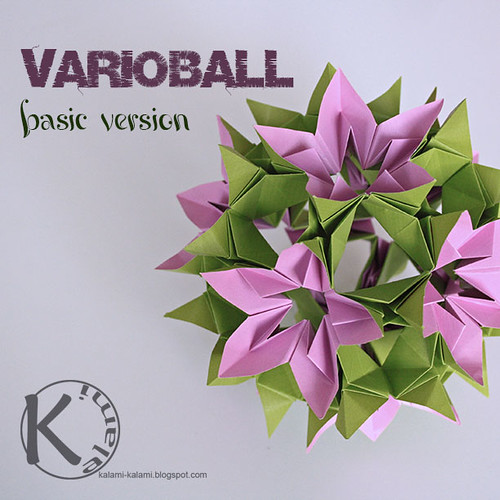
Schon vor einer ganzen Weile habe ich ein Modell von mir vorgestellt, das ich Varioball nannte. Grund für die Namensgebung war die große Vielfalt an Variationen, die man mit diesem Modul erreichen konnte. Was bisher irgendwie immer fehlte waren Bilder von diesen Variationen. Die oben gezeigte Version ist das Grundmodell, es ist relativ einfach zu falten und eine Anleitung gibt es im Tagungsband des 25. Treffens von Origami Deutschland.

Some time ago I presented a modell called Varioball on this blog. I chose this name because there are so many variations you can achieve, using this module. But until now there were no pictures of those other versions. The photo above shows the basic version, a quite simple module - it's diagram is published in the 25th convention book of Origami Deutschland.


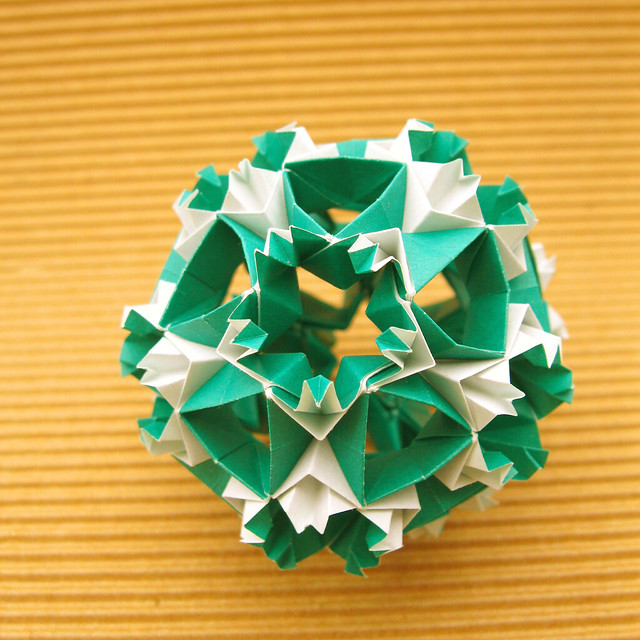
Bei der zweiten Version habe ich die Spitzen weggefaltet und die Mitte etwas verändert. So habe ich eine nach innen geklappte Faltung eingefügt ("inside reverse fold"), wie sie recht häufig von Kawasaki verwendet wird (z.B. bei der neuen Version seines Kirschblüten Balls). Das Ergebnis erinnert mich an Sterne.

For the second version I folded the tips away and played with the centre of the unit. I included an inside reverse fold like Kawasaki uses it over and over agai (e.g. in the second version of his cherry blossom ball). The result reminds me of stars.


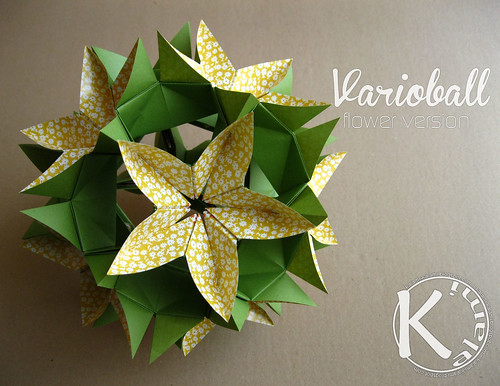
Die dritte Version ist nur eine Abwandlung der Mitte. Ich liebe diese Variante, weil sie so klare Formen hat.

The third version is only changed in the centre. I love this variation because of its clear appearance.


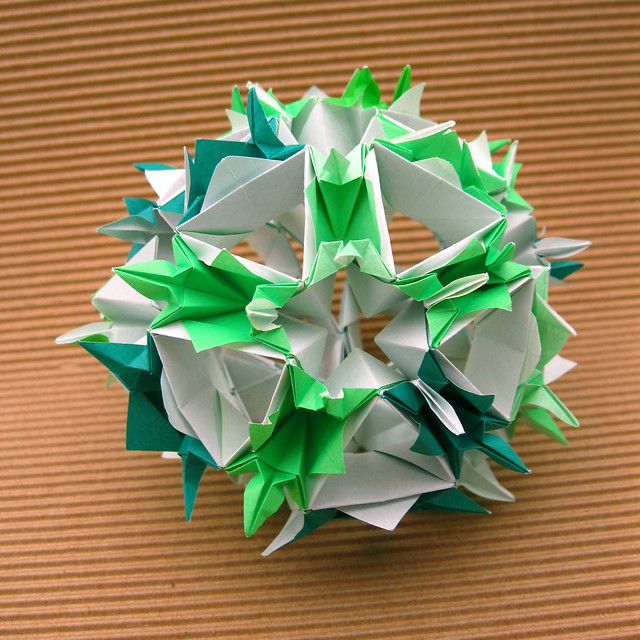
Die vierte Variation ist deutlich komplexer, ich habe deshalb ewig gebraucht, um die Kugel fertigzustellen. Doch ich denke es hat sich gelohnt. Während der Convention in Italien verliebte sich Viviane Berty sofort in das Modell, daher widme ich ihr diese Version.

The fourth Variation is much more complex, therefor it took me a long time to finish it. But I it was worth it. During the Italian Convention Viviane Berty instantly fell in love with it, so I dedicated it to her.


Eine letzte Variante habe ich quasi schon vor dem eigentlichen Varioball gefaltet, die "Version Marion" ist aber letztendlich nach dem gleichen Prinzip gefaltet.

A last variation is older than the actual Varioball, but the 2version Marion" is folded using the same technique.

Es gibt an sich noch viele weitere Variationen, also wer weiß, vielleicht gibt es ja noch irgendwann Eintrag Nummer drei zum Thema.

There are much more possibilities, so who knows, maybe there will be a third post about this topic some time.

Sonntag, 21. April 2013

Kleines Update

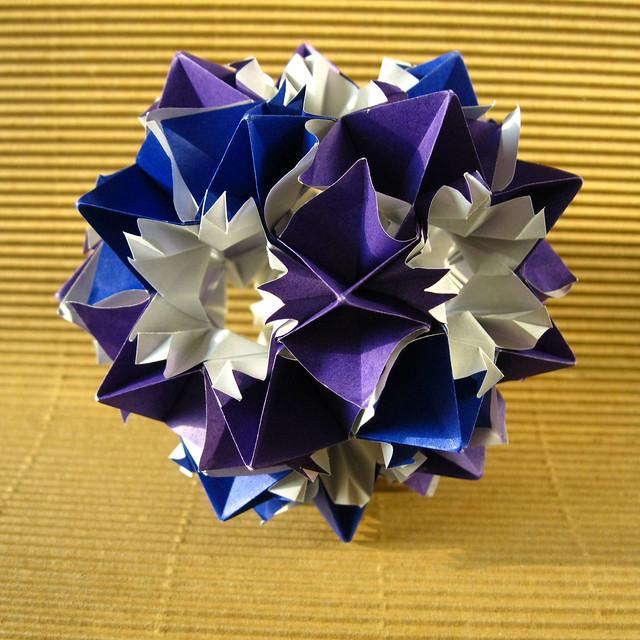
Vergangenen Sommer hatte ich die Idee für eine Kugel, deren Löcher zwischen den Modulen die Form von Sternen hat. Robin alias Praise Pratajev hatte das Modell für mich gefaltet:

Last summer I had the idea for a globe, where the wholes between the modules form a star shape. Robin aka Praise Pratajev folded it for me:

Photo by Robin Scholz (Praise Pratajev)

Allerdings war ich mit den Einzelmodulen nicht zufrieden, daher habe ich mir das Modell nun noch einmal angesehen und konnte endlich eine Verbesserung erzielen, die auch gleich eine Reihe an Variationen zulässt.

Nevertheless I was unsatisfied with the units, that's why I concentrated on the modell again and finally improved it. Now it is also possible to make some variations.


Dienstag, 15. Januar 2013

Varioball

In den vergangenen Tagen habe ich mir ein altes Modell vorgenommen und den Faltprozess vereinfacht. Dies ist nun das erste Resultat. Es gibt einige Möglichkeiten zum Variieren, die wiederum unterschiedlich kombiniert werden können. Aus diesem Grund bin ich auf den Namen "Varioball" gekommen.

The past days I took an old model and simplyfied the folding process. This ball is the first result. There are some variations possible, that can be combined in different arrangements, hence the name "varioball".


Freitag, 1. Juni 2012

Neueste Arbeiten - New Work


Es muss nicht immer modulares Origami sein!
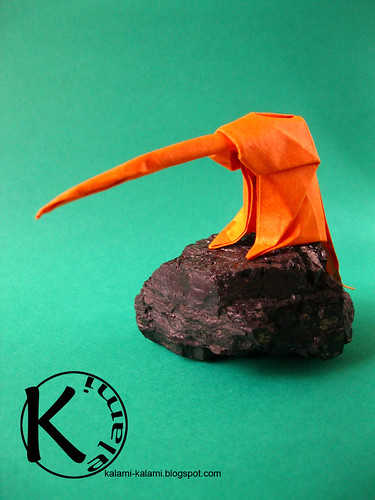
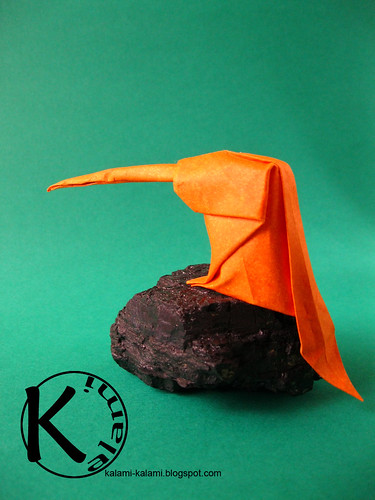
Eines meiner neueren Modelle ist ... nun ich würde sagen, es ist ein Vogel. Er hat immerhin einen Schnabel. Von der Größe - des Schnabels und des Körpers - her könnte es ein Kolibri sein. Allerdings fehlen dem kleinen Kerl Flügel. Das weist wohl eher darauf hin, dass es sich um einen Vogel aus Australien oder Neuseeland handelt. Also tippe ich, er ist eng verwandt mit einem Kiwi. Aber urteilt selbst:

No, it's not always modular origami!
One of my newest models is ... well, I would say it's a bird. It's got a beak at least. Judging by it's size - the beak and the body - it could be a hummingbird. On the other side there are no wings. This could be a hint, the little fellow comes from Australia or New Zealand. I would guess it is a relative of the Kiwi. But, take a look on your own:


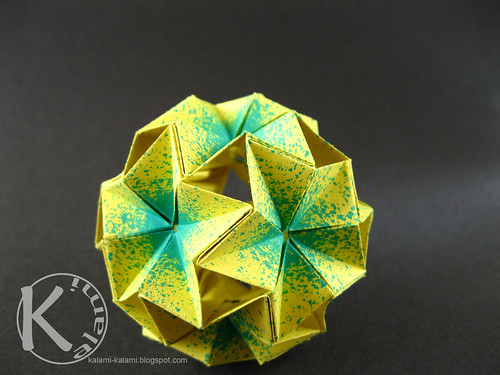
Das andere Modell ist, ähm, doch wieder etwas Modulares. Es ist eine entfernte Weiterentwicklung des Sepp Sterns, die aber leider keinen Farbwechsel zulässt. Da das Modell außerdem aus Rechtecken gefaltet wird, kann man auch kein Farbverlaufspapier verwenden. Um dennoch einen interessantes Farbspiel zu erhalten, habe ich meine neueste Errungenschaft, die sogenannten "Blo Pens" verwendet. Nein, ich habe kein "w" vergessen, die Stifte heißen wirklich so. Es handelt sich dabei um gewöhnliche Filzstifte, die mithilfe einer Art Blasrohr so eingesetzt werden können, dass das Ergebnis Ähnlichkeit mit Airbrushes hat.

The other model is, ähm, again something modular. It is the developement of Sepp's star, unfortunately without the possibility to make a colorchange. As the model is made of ractangulars, also paper with a gradient wouldn't work. To still gain some nice play of colors, I used my newest acquirement, the "Blo Pens" - no, I did not forget the "w". These are ordinary felt pens, which you can put inside a kind of blow pipe, to gain an effect close to airbrush.


Eine andere, weitaus komplizierte Variante des Sepp Sterns habe ich bereits vor mehreren Wochen gefaltet.

An other, far more complicated variation of the Sepp's star I already folded some weeks ago.


Freitag, 3. Februar 2012

Lass es blühen! - Let it bloom!

Schon vor etlichen Monaten habe ich dieses Kusudama entwickelt, nur bin ich einfach nicht dazu gekommen, es fertigzustellen und zu fotografieren. Den Prototypen hat meine Freundin Marion bekommen, deshalb nenne ich das Modell auch einfach Marions Kugel.

It's several months ago since I developed this Kusudama, but took me quite a long time to fold it and take a picture. The protoype was a present for my friend Marion and that's why I call it Marion's Globe.


Das Modell wird aus 30 Quadraten gefaltet und kann auf verschiedenste Weise variiert werden. Mal sehen, vielleicht schaff ich es ja schneller, Variationen online zu stellen.
 The Ball was made of 30 squares and can be varyed in many different ways. Let's see if I can fold and present some of those faster.

Dienstag, 6. September 2011

Vendetta!

Nein, keine Angst, das ist nur der Name eines modularen Origami Modells von Maria Vahrusheva. Ich habe es ein klein wenig variiert und das ist das Ergebnis:
No, don't be afraid! This is only the name of a piece of modular Origami by Maria Vahrusheva. I slightly varied it and this is the result:

 Diagram


Samstag, 14. Mai 2011

Laut gedacht - thinking aloud

Im vergangenen Beitrag habe ich Euch beschrieben, wie ich ein Modell immer weiter entwickle, bis es mir wirklich gefällt. Um all die schönen Variationen zu zeigen, habe ich zuerst alles gefaltet, bevor ich alles online gestellt habe. Was ich allerdings nicht wusste, war dass es das Modell "Summer" bereits gibt. Miyuki Kawamura hatte die gleiche Idee und zwar viel viel früher als ich. Ihr Modell heißt "Needle" und ist im Tanteidan Convention Buch 12 veröffentlicht worden. 
In the last entry I described, how I develop a new model, until I really like it. To show you all the beautiful variations, I folded everything, before I uploaded it. What I didn't know all the time was, that the model already existed. Miyuki Kawamura had the same idea much earlier. Her model is called "needle" and published in the tanteidan convention book 12.

So etwas kann passieren, da die Faltungen oft auf Grundformen basieren, die immer wieder in den Modellen auftauchen. Dennoch muss ich zugeben, dass ich mich darüber geärgert habe. Für das Modell "Summer" bedeutet das allerdings, dass ich keine Anleitung erstellen werde, weil ich nicht die ursprünglichen Rechte darauf habe.
Something like this can happen, because I often use basic forms, that appear in all the origami models on and on again. Even though I a bit frustrated about it. For the model "summer" it means, I can't make a diagram, because I haven't got the rights. 

Um in Zukunft früher über solch eine Dopplung bescheid zu wissen, werde ich nicht mehr warten, bis ein Modell endgültig fertig ist. Statt dessen zeige ich Zwischenschritte sofort. 
To avoid something like this in the future, I will no longer wait, until a creation process is finished. I will show you the steps of development  immediately.


Derzeit arbeite ich an einem Modell, das in der Mitte der 5 Module einen Stern bildet. Dies ist mein erster Versuch:
These days I'm working on a model with a star in the middle of 5 connected units. This is my first test:


Das Modell besteht aus 30 Modulen (aus quadratischen Papier gefaltet), die zusammengesteckt werden. Bisher stört mich aber die Art, wie die Einzelteile verbunden sind, denn dadurch werden sie stark zusammengeschoben. Die eigentliche Form des Moduls ist kaum zu erkennen. Daher arbeite ich derzeit an einer Verbesserung der Verbindungsstücke.
The model consists of 30 modules (made from square paper), that are connected without glue. But I don't like, how the units are connected, because it pushes the modules together. So you hardly can see its form. Therefor I'm trying to improve the connections.

Sonntag, 8. Mai 2011

Wie ein Modell entsteht. - How a model is invented.


 Arradia, der russische Shooting Star in Sachen Kusudamas, hat vor einiger Zeit diese wunderschöne Blüte entwickelt.

Arradia, the Russian Shooting Star in Kusudama, designed this beautiful flower some time ago.

Grundlage war die Margerite von MioTsugawa, die zwar schön aussieht, aber ein sehr großes Blatt erfordert, um ein vernünftiges Ergebnis zu erzielen.

It was based on the Margerite by MioTsugawa, which is really beautiful, but you need a big sheet of paper, to get a proper result.

Arradias Version besteht aus einem Modul pro Blütenblatt, die zusammengefügt eine Blüte ergeben. Sie machte dadurch viel einfacher, ein solches Kusudama zu falten. Jedoch störte mich außerdem, dass man bei beiden Modellen eine relativ hohe Anzahl an Modulen braucht, um eine Kugel zu erhalten. Seit Februar arbeitete ich daher an einem neuen modularen Origamimodell, dass dieses Blütenblatt integrierte und außerdem mit 30 Modulen für eine Kugel auskommt.

Arradia's version is made of one unit per petal, that form the flower, when you connect them. It's much more simple, to fold this Kusudama. But the problem about both models is, that you need a huge amount of modules, to form a nice globe. Since february I've been working on a new Origamimodel, which contains those petals and forms a globe with the usual number of 30 units.

Lange Zeit waren die Ergebnisse niederschmetternd, bis ich endlich Mitte März dieses Modell in den Händen hielt:

Long time the results where depressing. Finally, in the middle of march I was holding this in my hand:

Doch ich muss Euch gleich enttäuschen, es entspricht nicht meinem Qualitätsanspruch, denn beim Zusammenfügen musste ich kleben.

But I have to disappoint you, it's not what I wanted to make, because I needed glue to join the modules.

Version Nummer Zwei erhielt daher eine zusätzliche Faltung, um die einzelnen Module fester miteinander zu verbinden. Das funktionierte aber nicht zufriedenstellend. Die fertige Kugel rutschte immer wieder auseinander.

Version number two had an additional crease, to hold the units together. This worked only a little. The finished globe was falling to pieces on and on again.

Letztendlich hatte ich die Idee, dass die Spitze in der Mitte die einzelnen Module zu sehr zusammenzieht. Ich versuchte also, die Spitzen einzusenken und siehe da, es funktionierte!

Finally I had the idea, that the tips in the middle of the unit where pulling it too much together. So I sunk the tips, et voilà:

Noch war das Ergebnis sehr fragil, doch schon bald kam ich auf eine Variante, die eine stabile und ansehnliche Kugel formte.

Still the model was quite fragile, but already the next Variation was a stable and good looking globe.

Nun gab es kein Halten mehr! Schnell kam ich auf eine weitere Variante.

Now no one could stop me! Quickly I found a new Variation.

Schließlich wollte ich nun das Blütenblatt einfalten, was ja mein ursprüngliches Ziel war. Und da fing es dann wieder an. Das Ergebnis sah einfach doof aus! Es war eiförmig und die Blütenblätter waren so winzig, das man eine Lupe brauchte, um sie zu erkennen. Außerdem zogen die Blütenblätter die Module wieder viel zu stark zusammen.

After all I wanted to fold the model with the petal, which was the original aim. The result was just ugly! The shape looked like an egg, not a globe, the petals where so tiny, you needed a magnifier, to see it and the petals where pulling the modules together again.

Es war mittlerweile Mitte April und ich konzentrierte mich noch einmal stärker auf die Blütenblätter. Ganz plötzlich, innerhalb von vielleicht 30 Minuten, hatte ich dann ein neues Modul in der Hand. Es hatte ein großes Blütenblatt, Flügel und Tasche und die Winkel schienen auch zu stimmen. Mein erster Gedanke war allerdings, diese Verbindung wird niemals halten, das ist viel zu locker. Mein zweiter Gedanke war, probiers trotzdem. Gut, dass ich es gemacht hab, hier ist das Resultat:
Edit: Es tut mir leid, aber war nicht die erste, die diese Idee hatte! Lest dazu mehr in diesem Beitrag.

It was the middle of april now and I started in concentrating is far t on the petals again. Suddenly, after just about 30 minutes, I was holding a new module in my hand. There where big petals, a flap and a pocket and the ankles seemed to fit. My first thought was, this will never work, the connection is far too loose. My second thought was, well try it! Lucky me, I did it, here is the result:
Edit: Sorry, I wasn't the only one, who had this idea! Read this post for more informations.

Kann sich sehen lassen oder?
Die folgenden Tage faltete ich weiter, denn mir fiel auf, dass man aus den Spitzen, die die Blütenblätter formen, noch so vieles mehr machen kann.

Looks nice, doesn't it?
The following days I one model after the other, since I recogniced, how many variations I can make with the tips, that form the petals.

Variante um Variante fiel mir ein

Variation after variation was made

und derzeit falte ich schon wieder an einer neuen Version!

and these days I'm folding another one.